
 Visit UK Site ↗

 Installation
X Series
Installation video
Step-by-step guidance for installing an X Series unit.
Watch video →Find installation, operation and maintenance guidance for your Grease Guardian equipment.
16 videos · All videos
Installation
X Series
Step-by-step guidance for installing an X Series unit.
Watch video → Installation
X Series
Learn how to configure automatic skimming times and cycles.
Watch video → Maintenance
X Series PRO
Essential daily-care guidance for X Series PRO equipment.
Watch video → Maintenance
X Series PRO
Complete the scheduled cleaning routine for X Series PRO.
Watch video → Maintenance
X Series PRO
Review and change the X Series PRO maintenance settings.
Watch video → Maintenance
X Series
Essential daily care for dependable X Series performance.
Watch video →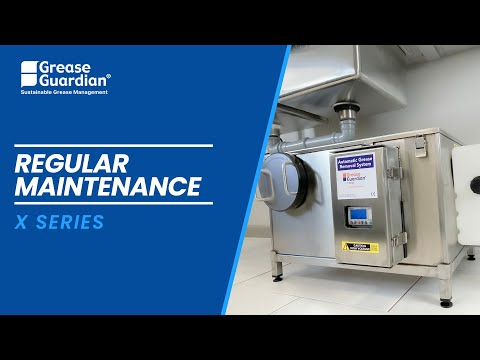 Maintenance
X Series
A detailed cleaning routine for your X Series unit.
Watch video → Maintenance
D Series
Simple daily care tasks for maintaining a D Series unit.
Watch video → Maintenance
D Series
Routine cleaning and inspection guidance for D Series equipment.
Watch video → Operation
X Series
See how the automatic grease-skimming process operates.
Watch video → Operation
X Series
Safely remove, empty and clean the solids strainer.
Watch video → Operation
X Series
Follow the correct steps for removing and cleaning the blade.
Watch video → Product video
Grease Guardian
An overview of at-source automatic grease removal equipment.
Watch video → Product video
Grease Guardian
Discover grease-management equipment designed for marine use.
Watch video → Product video
Grease Guardian
Explore centralized systems for larger-capacity applications.
Watch video → Product video
Grease Guardian
An introduction to the GGX Pro automatic grease removal range.
Watch video →Download practical guidance for your kitchen team or visit the Grease Guardian USA support center.
Grease build-up happens when fats, oils, and grease (F.O.G.) are washed down the drain during cooking and cleaning. Over time, F.O.G. solidifies in pipes and sticks to pipe walls, often combining with food scraps and debris.
When it comes to grease traps most cities have their own Plumbing Codes which are usually based on either the Uniform Plumbing Code (UPC) devised by the International Association of Plumbing & Mechanical Officials (IAPMO) or the International Plumbing Code (IPC) devised by the International Code Council. IPC is used in around 37 States and UPC in most of the others largely located in the West Coast.
Grease Guardian products are approved against all the above standards mentioned in both the IPC and UPC. The sizing criteria is also mentioned in the codes and a licensed plumber will be able to identify the correct size of unit needed
A grease trap is a device used in commercial kitchens to capture fats, oils, and grease (F.O.G.) before they enter the drainage system. F.O.G. is lighter than water, so it rises to the top while the clear water flows out, keeping pipes protected.
Without a grease trap, F.O.G. can cause blockages, foul odors, and costly plumbing issues. Many local authorities require grease treatment in commercial kitchens, and failing to comply can result in fines.
Traditional grease traps need monthly manual cleaning, but an Automatic Grease Removal Device like Grease Guardian® removes grease daily, keeping your kitchen compliant, reducing maintenance, and protecting your pipes.
There are several ways to manage grease, each with different benefits and limitations:
Manual or Passive Grease Traps: Grease rises to the top of the trap and must be removed by hand. They are simple and inexpensive but require frequent cleaning and can lose efficiency over time.
Automatic Grease Recovery Devices (AGRDs): Devices like Grease Guardian® separate and remove grease daily using mechanical skimming and heat. They require minimal maintenance, prevent blockages, and store grease safely.
Enzyme or Bacterial Systems: Biological agents break down some grease in pipes or traps. While useful for small amounts, they may emulsify grease and pass the problem downstream once it solidifies.
Chemical Treatments: Chemicals can disperse grease in pipes, but they don’t remove it completely and can damage plumbing over time.
In-Ground or Large-Scale Interceptors: These handle higher flows for multiple sinks but require regular pump-outs, and efficiency drops as grease accumulates.
Tip: For consistent, low-maintenance results that protect your pipes and kitchen, automatic grease removal devices like Grease Guardian® are the most reliable solution.
Grease Guardian® is the most efficient form of grease treatment on the market. Installed at the source, it removes grease daily, keeping drains clear and kitchens compliant.
Unlike in-ground traps, which lose efficiency as grease builds up and require costly regular cleaning, Grease Guardian® consistently separates and stores grease. Enzyme systems may remove some grease from pipes but can emulsify it, passing the problem downstream once it solidifies again.
Grease Guardian® stands out from competitors in quality and performance:
Stainless steel tank: Fully sealed, not moulded plastic.
Highest capacity per flow rate: Handles more grease efficiently than other brands.
Energy-efficient heating: Ensures even solid fats are skimmed.
Up to 5-year warranty: Confidence backed by results.
Grease Guardian® is a modern solution to an old problem, protecting pipes, reducing maintenance, and keeping your kitchen running smoothly.
A fatberg is a large, solid mass that forms in sewers when fat, oil, and grease (FOG) combine with non-biodegradable items like wet wipes, paper towels, and sanitary products.
Here’s how it happens :
When restaurants or homes pour grease and oil down the drain, they cool and solidify inside pipes.
These fats then bind with wipes and debris, creating sticky, waxy clumps.
Over time, these clumps grow into massive, rock-like formations — blocking sewers and causing overflows.
Why it’s a problem:
Fatbergs can completely block wastewater flow, leading to backups, flooding, and costly repairs.
Removing them is labour-intensive and expensive — some have weighed several tonnes and stretched for hundreds of feet.
How to prevent them:
Installing grease traps or automatic grease removal devices (AGRDs) (like Grease Guardian®) stops fats, oils, and grease from entering drains in the first place — preventing fatbergs at their source.
Passive Traps: These require frequent maintenance — ideally every 1–2 weeks — to remain effective. If neglected, grease can escape or build up, especially if the trap was undersized or your business has expanded. Monthly emptying is necessary but can be costly.
Enzyme/Bacteria Systems: These may not break down grease efficiently and require regular top-ups, adding expense. Some councils may also discourage their use.
Other Grease Removal Devices: Many have small tank sizes, allowing grease to escape, or are made from plastic, which is prone to leaks or breakdowns.
Grease Guardian®: Designed to prevent grease build-up at the source — potwash sinks, ovens, and other key points — by automatically removing grease daily. It protects your kitchen, reduces maintenance, and safeguards the local environment without the need for enzymes or bacteria.
Grease collected by Grease Guardian® units should be stored like spent fryer fat and supplied to grease rendering companies for recycling, a common practice in most markets. Collected grease is increasingly used to produce bio-diesel, and demand for this sustainable resource is growing.
The Grease Guardian® automatically separates and removes fats, oils, and grease from kitchen wastewater. For a full demonstration of the process, you can watch our video here.
No. The Grease Guardian® does not need the heating element running continuously. To conserve energy and reduce costs, the heater operates for 2–3 hours per day — only when the effluent temperature is below 40°C. Grease remains trapped in the unit for 12–24 hours until it is skimmed during this heating period. In economy mode, the heating element can be turned off entirely.
Daily maintenance of a Grease Guardian® takes no longer than a couple of minutes. For full instructions, scroll to the top of this page to watch our maintenance videos, or download the complete maintenance guide.
Yes, the Grease Guardian® is ideal for kitchen installation. It is CE-rated, meeting the latest European safety standards, and its grease removal units have achieved HACCP certification. Made from stainless steel, the unit maintains full food hygiene standards.
Choosing the right Grease Guardian® depends on the kitchen appliances and fixtures discharging into the unit. For guidance, you can use our online sizing guide to find the model that best suits your establishment, or contact us directly. Our team is happy to help you select the ideal unit for your requirements.
It’s generally not recommended to connect dishwashers to a Grease Guardian®. Some very small units may be connected without issues, but dishwasher detergents can emulsify fats and oils, allowing them to pass through any grease trap. To maximise efficiency, fats, oils, and grease should be kept out of dishwashers wherever possible. Good housekeeping practices are essential — scrape food waste into bins first, then rinse utensils in a pre-rinse sink connected to the Grease Guardian®. View our Best Kitchen practices here.
The Grease Guardian® is sold in over 50 countries worldwide. For more than 30 years, our products have been supplied to leading hotels, restaurants, supermarkets, and fast-food chains across the globe. To find a representative near you, visit our Global Representatives page and select your country.
Yes — like most effective systems, the Grease Guardian includes some moving parts. However, it’s built with only a few key components — the wheel, motor, and gears — which operate for just 30 to 60 minutes a day, ensuring minimal wear and a long service life. All parts are made from high-quality, durable materials, not plastic like many other systems on the market. Unlike units that rely on natural separation processes, which can be unpredictable, the Grease Guardian delivers consistent, programmed performance every day.
If you wish to be considered as a Grease Guardian distributor in a market where Grease Guardians have yet to be represented, contact us today.
We ship across the U.S. either directly or through our partners, Webstaurant and Amazon.
If you are based outside the U.S. please visit our Global Representatives page and search for your country to find your local distributor.
Prevention is better than cure. Try and reduce the amount of fat and food waste going to drain by using strainers and grease traps. View our Best Kitchen Practices.
Grease Guardian offers sustainability at every level:
Built to Last: Unlike plastic grease traps that degrade over time, Grease Guardians are made entirely of stainless steel — reducing replacement waste and environmental impact.
Space-Saving Design: Their compact size allows installation in tight urban kitchens, eliminating the need for large inground traps that require extensive space and site disruption.
Reduced Carbon Emissions: Grease Guardians automatically remove and store grease, significantly reducing the need for pump-out trucks. Traditional traps often need frequent service visits, increasing emissions.
Supports Circular Economy: The collected grease is clean enough to be repurposed by rendering companies, similar to used cooking oil. In contrast, waste from traditional traps often ends up in landfill.
Easier Compliance, Less Risk: With automatic grease removal, there's no guesswork or reliance on manual schedules — meaning fewer missed pump-outs and less burden on local authorities.
 What causes grease build-up in commercial/industrial kitchens?